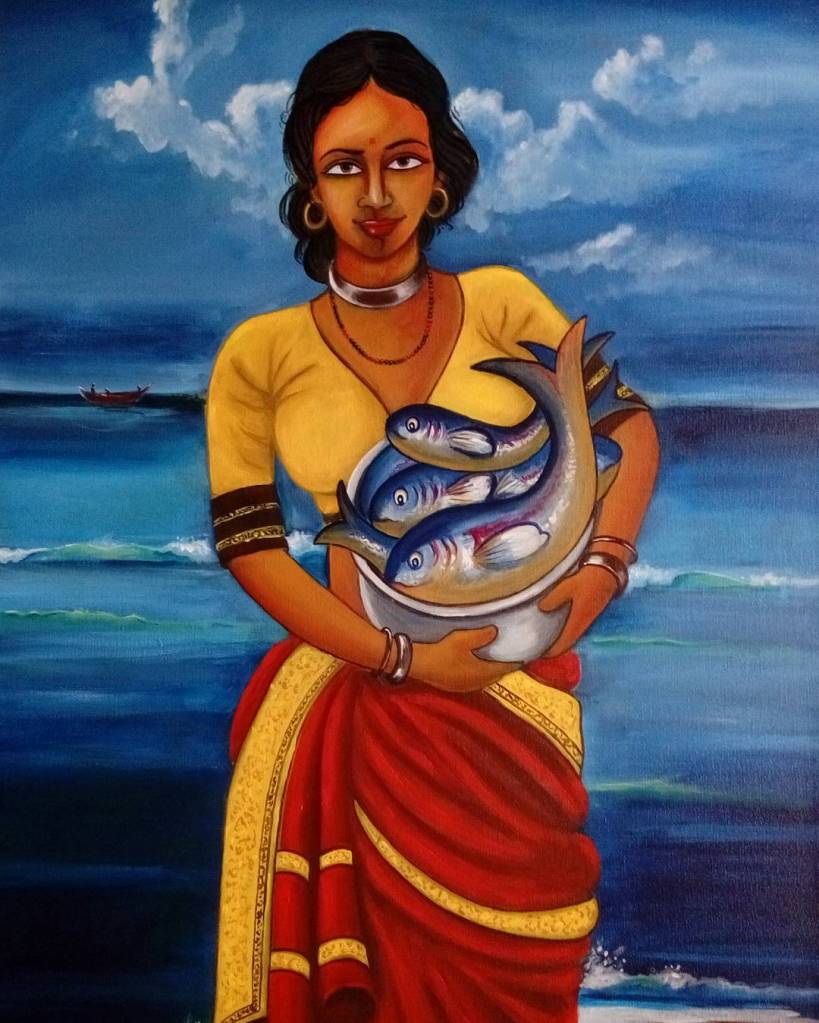
The story of Matsyagandhi, relies on the fisherwoman who narrates the struggles and hardships of her community as well as the discrimination she undergoes within her community.
The play is a dramatic monologue and we are introduced to only women characters throughout – Satyavati who was cursed of the fish smell yet got the better end of it, Kadalamma the sea Goddess whose children are murdered and her home decaying at the filthy hands of men, as men always appear to do, a mention of Flory the fisherwoman who was sexually exploited in broad daylight in Kerala and lastly the Speaker whose rage towards all the misgivings the women endure and misery over the globalized world, ultimately sets the tone of the play.
Arachne is a famous story in Greek mythology and it depicts the basic principles of punishment and discipline, which are established over women’s creativity, especially when perceived as engaged or transgressive, are identified both in the myth itself as well as in daily life.
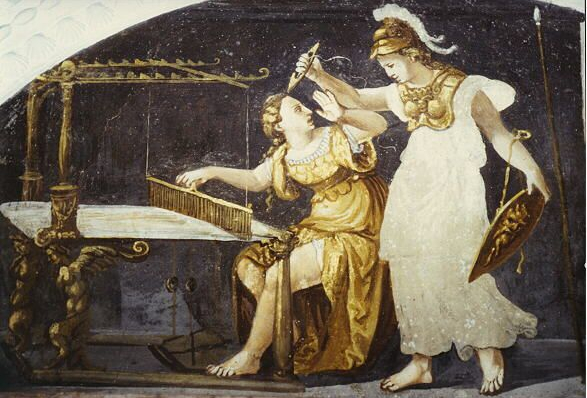
Arachne was a young woman whose weaving skills were so remarkable and beautiful that she attracted the attention of the Goddess of Weaving Minerva who was more famously known as Athena. Arachne maintains her position that she was not taught by Minerva and is superior to her. Aware of these boasts, Minerva comes to Arachne disguised as an old woman. She advises Arachne to beg the goddess for pardon to which Arachne refuses and accepts Athena’s challenge to see the best weaver. Where Arachne depicts many immoral actions of the gods and their mistreatment of mortals in her tapestries of art. Minerva is unable to handle her defeat, and destroys Arachne’s weaving and begins to hit the girl with a shuttle. Minerva’s rage drives Arachne to hang herself. However the goddess takes pity on her, and instead of letting her die, transforms her into a spider, ironically cursing Arachne and her descendants to weave for all eternity.
Now that the background of the two stories have been established, the main part of this study which is a feminist perspective will now be discussed.
In ancient Greek and Roman culture, weaving and spinning was a conventional signifier of female virtue as defined by culturally specific constructions of a woman’s duty or obligation to her house and family that implied a loyalty to the state and reverence for the gods. The myth focuses on the arrogance of Arachne’s belief in the autonomy of her textile production. Arachne is supposed to accept that she is nothing more than a vessel for the transmission of the creative power of the gods, that women lack the authority to create independently.
In India, a woman’s sole duty was considered to be taking care of the family, confined within her jail of 4 walls with hungry mouths to feed, to never express her opinion and live her life out unaware of the rights she possesses and the power she could possibly hold if she breaks free from the patriarchal society’s hetero-normative, dominant and conservative norms.
Matsyagandhi dishes out all the truth and facts of how the caste system discriminates against the fishermen community and they are looked down upon by the rest of the society despite the food on their table being served by the very same fishermen. And the women in the fisherpeople community are taunted, harassed, sexually tormented and treated like garbage by the rest of the society and their own community.
Even the Sea Goddess Kadalamma who is given a female perspective, too is not free from male domination. The sea mother is swallowed by the huge hands of globalisation and unsafe in today’s world where with reference to eco-feminism, is another instance of nature and women hurting at the hands of men.
A major similarity is when Arachne weaves tapestries of the stories she depicts include Europa and Prosperpina, who were both raped by Jupiter as well as other Gods who have committed crimes such as these and other arrogant acts. Because they hold power, they truly believe themselves to be invincible and not accountable to anyone. Just like the government and authoritarians in Matsyagandhi who with the turn of globalization, forget all the lives it affects and ignore the sufferings of the lower caste communities.
The Greek Gods had devout mortals who worshiped them at the altar and offered them fruits, wine, and their hearts. The people and Gods were supposedly on the same side in a long battle against Titans and any monster that dared to try to bring them down. Yet the Gods laughed at the mortals and exploited, manipulated and played with the people of their own team. This is an unsubtle comparison to Matsyagandhi who spills her frustration of being mistreated by people of their own community, where even the fishermen did not give the women a break despite being on the team, same side.
There is an element of irony in the story Matsyagandhi as the pathetic lives of the fisherwomen don’t match with Satyavanthi’s life in the original story: their lives are tragic.
To quote J Richards, “Continuing the work of Arachne’s web: developing new techniques of feminist reading, keeping women’s voices present and powerful – these are what I see as the tasks and challenges for Arachne’s daughters in the twenty-first century.”
 Mono
Mono 